
Transparency Note: This manual contains affiliate links. If you book through them, I earn a small commission at no extra cost to you. This keeps my EV charged and allows me to provide unfiltered, field-tested travel insights.
Every photo I’d seen of the Korea cherry blossom tunnel in Hadong made it look like a gentle lane draped in white petals — the kind of place where you stroll with a warm drink and forget what day it is. It isn’t that. Or rather, it is exactly that, but only if you arrive before 7 a.m. After that, the 6 km two-lane road between Hwagae Market and Ssanggyesa Temple becomes a parking lot with no shoulder, no U-turn, and no escape for two to three hours.
Hadong sits about 3.5 hours south of Seoul by car (or KTX to Jinju, then a 60-minute drive west), and about 2 hours west of Busan via the Namhae Expressway. The Hwagae Valley runs along the foot of Jirisan, Korea’s highest mainland mountain, and the cherry trees lining the road here are not young ornamental plantings. They are 50- to 100-year-old specimens, roughly 1,100 of them, planted by locals in the 1930s when the road from Hwagae Market to Ssanggyesa was first paved. The canopy they form overhead is dense enough to block most of the sky — and that density is what separates this from every other blossom spot in the country.
I came for the light. I stayed because the logistics nearly broke me and I wanted to write down exactly how to avoid what happened.
What Makes This Korea Cherry Blossom Tunnel Different from Jinhae or Yeouido
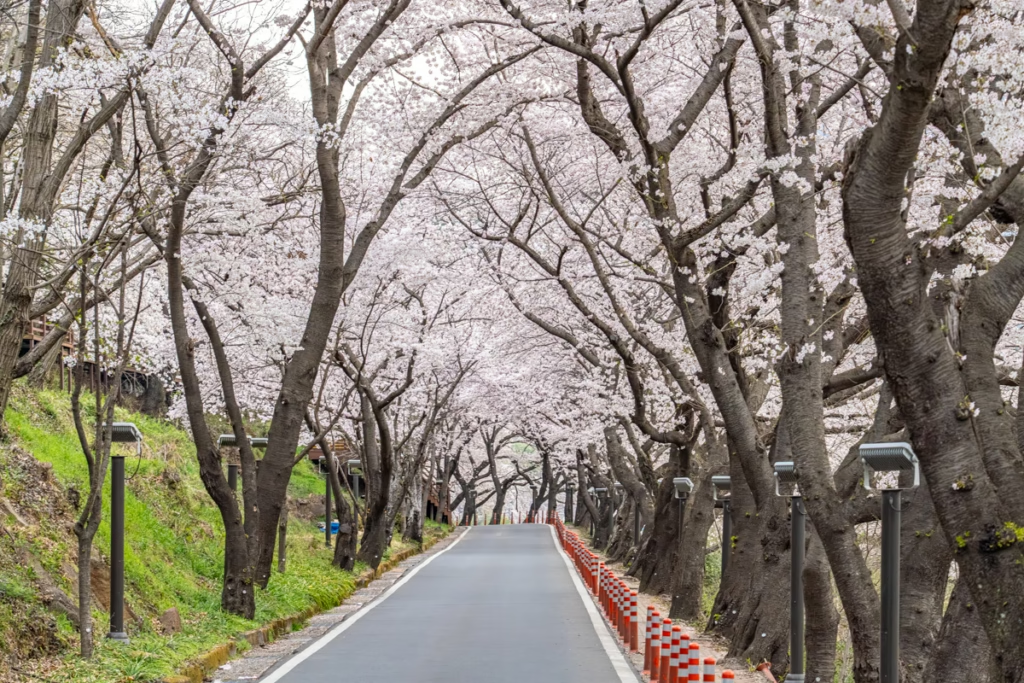
I noticed something within the first ten minutes of walking that no photograph had ever communicated. The canopy height. Seoul’s Yeouido or Jinhae cherry trees are mostly young — tall enough to form a backdrop, but not an enclosure. Here, the branches reach from both sides of the road and lock together overhead at about four meters. The effect is less “row of flowering trees” and more “standing inside a white cathedral nave.”
The thing no one mentions is the tea fields. Both sides of the road, between the tree trunks, are solid green with Hadong’s famous wild tea bushes — evergreen year-round, so in early April the color contrast is white canopy pressing down on a bright green floor, bisected by the grey asphalt of the road and the pale gravel of Hwagae Stream running alongside. I’ve been here three times, and every time I forget about the stream until I hear it. The water is clear enough to see the bottom from the road, and the sound is the kind of low continuous white noise that makes the silence between the petals feel deeper.
Walk into the village lanes that branch off the main road. The houses are low and clustered, and there is a quality to the streets that feels like the opposite of a festival — washing hung on lines, dogs sleeping in doorways, an elderly woman selling handpicked tea leaves from a plastic table. This is where the road earns its other name: Hongnye-gil (혼례길), the Wedding Road. Local legend says any couple who walks the full 6 km hand-in-hand will stay together for a hundred years. Whether that’s true is above my pay grade, but I can confirm it slows your pace down, which is the point.
2026 Bloom Timing, Live CCTV, and the Window You Can’t Afford to Miss
The Hadong blossom corridor does not bloom uniformly. Hwagae Market sits at a lower elevation than Ssanggyesa Temple, so the southern end of the road opens first — sometimes by three to five days. What caught me off guard was how fast the gap closes. On March 29, the Ssanggyesa end was still at 50% bloom. By March 30, the entire 6 km corridor had reached full peak. One warm afternoon did that.
Peak bloom holds for roughly five to seven days before the petals begin to scatter. The scattering itself is worth seeing — the road surface turns white, the stream carries drifts of petals downstream, and there’s a specific hour in late afternoon when the petals fall continuously like slow snow. But once it starts, you have maybe two days before the canopy thins enough to lose the tunnel effect.
How to check before you drive: Hadong County operates a real-time CCTV bloom tracker at flower.hadong.go.kr. Bookmark it. The cameras cover multiple points along the road, so you can see the differential — Hwagae side fully open while Ssanggyesa still holds buds, or vice versa. This is the single most useful planning tool for the trip and almost nobody outside Korea knows it exists.
The 27th Hwagae Market Cherry Blossom Festival ran March 27–29, 2026 this year, with evening concerts, a flea market, green tea tasting, and a wedding-road photo zone. The festival itself is short, but the bloom outlasts it. Honestly, the days right after the festival ends can be better for photography — the vendor stalls come down, the loudspeakers go quiet, and the road returns to the trees. If you arrive a couple of weeks too early for the cherry bloom, the plum blossoms across the Seomjin River in Gwangyang are usually at their peak instead.
Parking, Traffic Control, and the Only Strategy That Actually Works
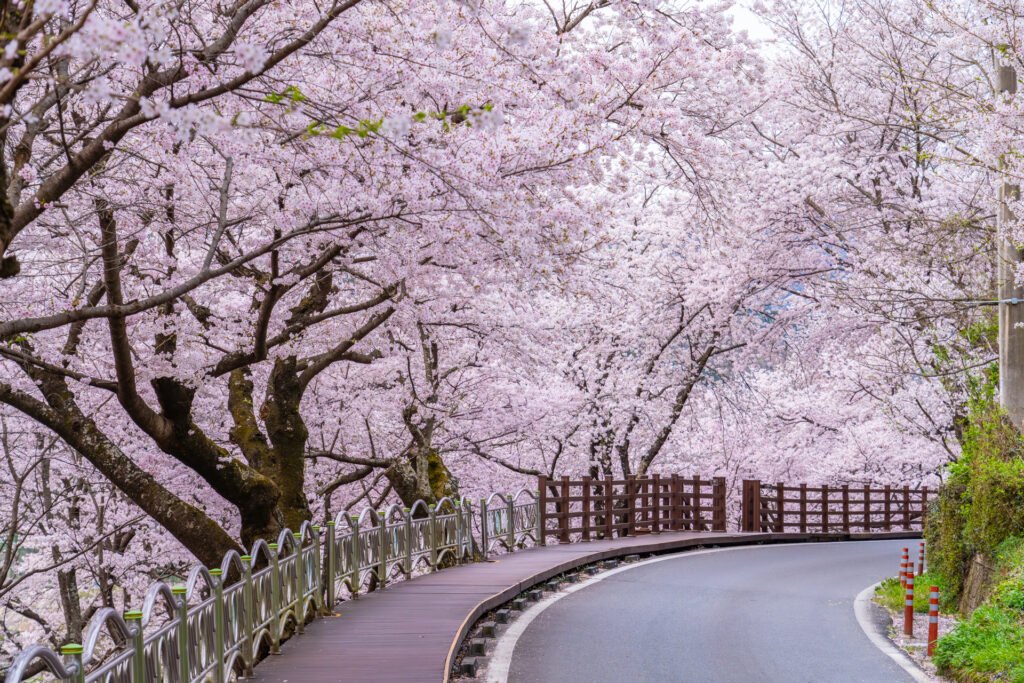
I’ll be direct: the traffic situation during peak bloom is genuinely terrible. The road between Hwagae Market and Ssanggyesa Temple is a single two-lane road with no bypass. When it clogs — and it will — there is no alternative. I watched a line of cars move less than 1 km in 90 minutes on a weekday.
During festival weekends and the following weekend (this year, March 28–29 and April 4–5), the section from Hwagae Middle School to Dongrim Motel is designated a car-free pedestrian zone with one-way traffic flow on the remaining open sections. Navigation apps often don’t reflect these temporary controls, so you can end up routed into a dead end. Check Hadong County announcements before departure.
Parking options:
- Hwagae Market public lot — first hour free, paid after. Fills by 8:30 a.m. on any bloom-period day.
- Ssanggyesa Temple public lot — available but smaller, and the approach road narrows.
- Roadside temporary lots along the stream — festival-period only, pricing changes without notice.
- EV charging: slow chargers at Hwagae Market Lot 1, Hwagae-myeon Office, and Ssanggyesa lot. All are low-count stations with high competition — do not plan your charge around these during peak bloom.
The strategy that works: arrive before 7:00 a.m., park at Hwagae Market, and walk in. The 6 km is flat and takes about 90 minutes at a comfortable pace. At that hour, the road is yours. By 9:30, the same road will be impassable by car and crowded on foot. If you’re staying nearby, a late-night arrival (after 10 p.m.) also dodges the gridlock entirely, because the traffic melts away after dark. On foot during peak hours, you will be faster than any vehicle on this road — that is not an exaggeration.
Night Cherry Blossoms and Driving Precautions Along the Simni Road
The Korea cherry blossom tunnel is not just a daytime walk. Landscape lighting runs along the road during peak bloom, and a slow drive through the canopy at night — petals glowing white against a black sky, the headlights catching drifts of fallen blossoms on the asphalt — is a genuinely different experience from the morning walk. Lighting hours shift with bloom status and weather; confirm with Hadong County (☎ 055-880-2651) before planning a night visit.
Two things to know if you’re driving the road at any hour. First, pedestrians and vehicles share the road along most of the 6 km. Dedicated deck walkways exist on some sections, but elsewhere the boundary between sidewalk and road is vague, and people stop mid-lane to photograph. Drive below 20 km/h and expect to stop frequently. Second, restrooms are scarce between Hwagae Market and Ssanggyesa. Use the facilities at either end before entering the road. This is the most consistently cited complaint in Korean reviews, and it is fully justified.
Kensington Resort Jirisan Hadong — Why Location Outweighs Everything Else
I’d skip this section if you’re not staying overnight, but if you are — and you should, because the dawn walk is the entire point — then accommodation options in the Hwagae area are surprisingly thin. There are a handful of pensions and minbak scattered around, but nothing with consistent quality, breakfast service, or a front desk that answers the phone after 9 p.m. Kensington Resort Jirisan Hadong (켄싱턴리조트 지리산하동) is the one exception, and it sits 500 m from Ssanggyesa Temple, which means it’s at the far (quiet) end of the blossom road.
The location logic is simple. Check in the night before — late, after traffic dies. Sleep. Wake at 5:30. Walk out the back gate, past the bamboo grove trail behind the resort, and you’re on the Simni Road before anyone from the Hwagae Market end has even started their engine. I did exactly this, and for the first 40 minutes I shared the road with two joggers and a temple groundskeeper.
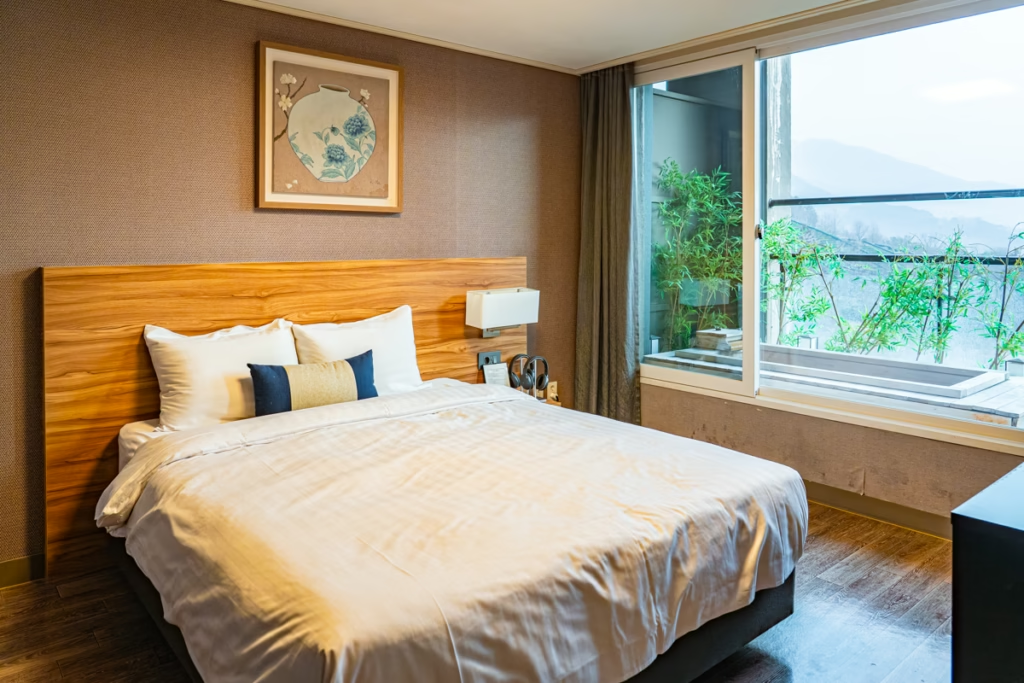
The resort itself has age on it. Lobby’s been renovated, but standard rooms show their years in bathroom fixtures and wall soundproofing. Voices carry between balconies. What the photos don’t show is the gap between the renovated public spaces and the rooms themselves — it’s noticeable, and if you’re expecting a new-build hotel finish, recalibrate. But here’s the honest math: name another property within walking distance of the Simni Road that has a restaurant, a convenience store, a cafe, and outdoor barbecue facilities. There isn’t one. That’s why it books out weeks ahead every spring, and that’s why I keep coming back.
Every guesthouse within walking distance was fully booked when I arrived on the Saturday of a long weekend — a mistake I won’t repeat. If you’re planning to visit during peak bloom, booking at least 3 weeks ahead makes a real difference.
Search available rooms near Ssanggyesa Temple →
The Deluxe Spa Room: Terrace Hinoki Tub with a View of Jirisan
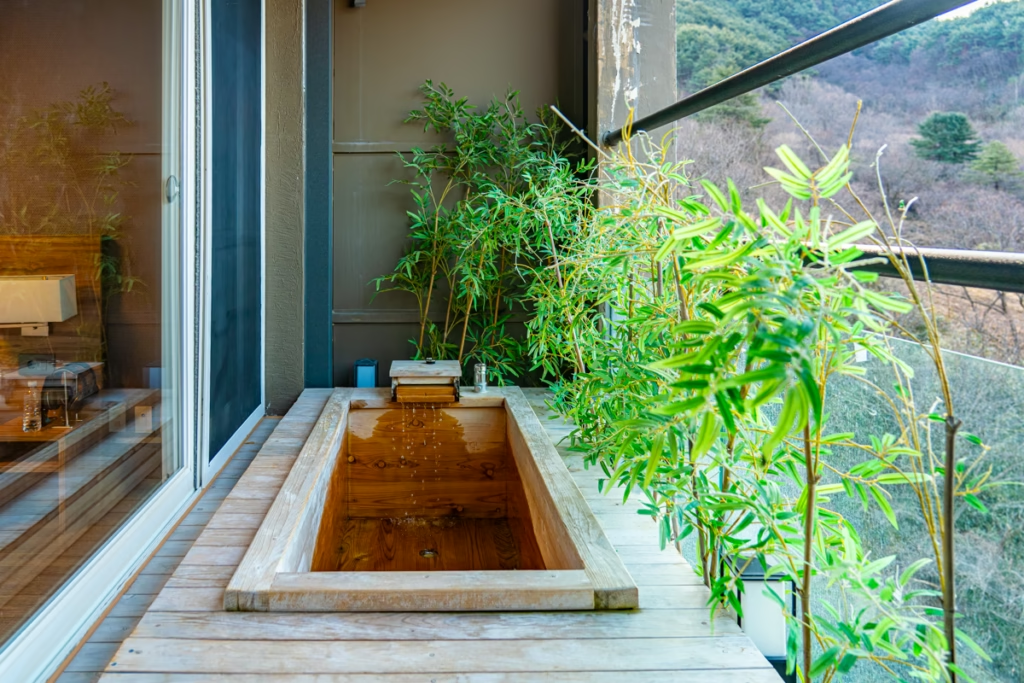
The room I booked was the Deluxe Spa type — the one with a hinoki (Japanese cypress) soaking tub on a private terrace facing Jirisan. This was, honestly, the deciding factor over every pension option I’d considered.
The tub is outdoors. You fill it with hot water yourself — takes about 15 minutes — and the moment you settle in, the hinoki wood releases a warm, resinous scent that rises with the steam. The air outside in early April was cold enough to sting my face, and the water was hot enough to make my shoulders unclench for the first time in weeks. That temperature differential — cold air, hot water, mountain dark — is the entire experience. My first instinct was wrong: I assumed the terrace would feel exposed. It doesn’t. The angle faces the mountain, not the parking lot, and the only thing above you is sky.
One note: the terrace partitions between rooms don’t extend to the ceiling. Conversation from next door is audible. Late evening or early morning are the quiet windows. I used the tub at 11 p.m. and again at 5:30 a.m., and both times I heard nothing but water and wind.
Inside, the ondol (heated floor) runs hot — genuinely hot, the kind where you sleep on top of a single blanket and still feel it radiating at 3 a.m. The bedding is clean and firm. For a resort showing its age elsewhere, the sleeping comfort surprised me.
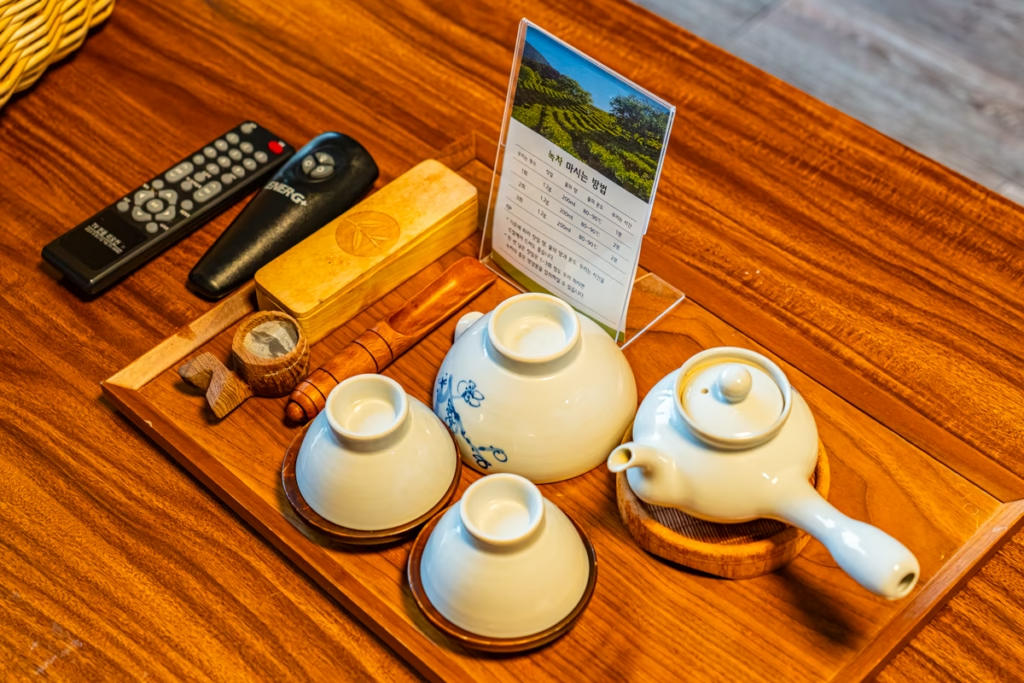
A small detail that landed well: each room comes with a traditional tea set (다기세트) and complimentary Hadong green tea. After the tub, I sat on the terrace chair and brewed a pot. The green tea here tastes grassier and less bitter than the commercial brands — closer to the smell of the tea fields along the Simni Road than to anything I’ve had from a bottle. The tea set is a loaner, and breakage costs ₩30,000, so handle it with the respect it quietly demands.
Breakfast Buffet: 50 Dishes Built Around Seomjingang Clams
The morning buffet runs under the name “Taste of Hadong” (하동의 맛) in the basement-level Numaru Korean restaurant. Entry closes at 09:30 — not flexible, not negotiable, and easy to miss if you’ve been walking the blossom corridor since dawn.
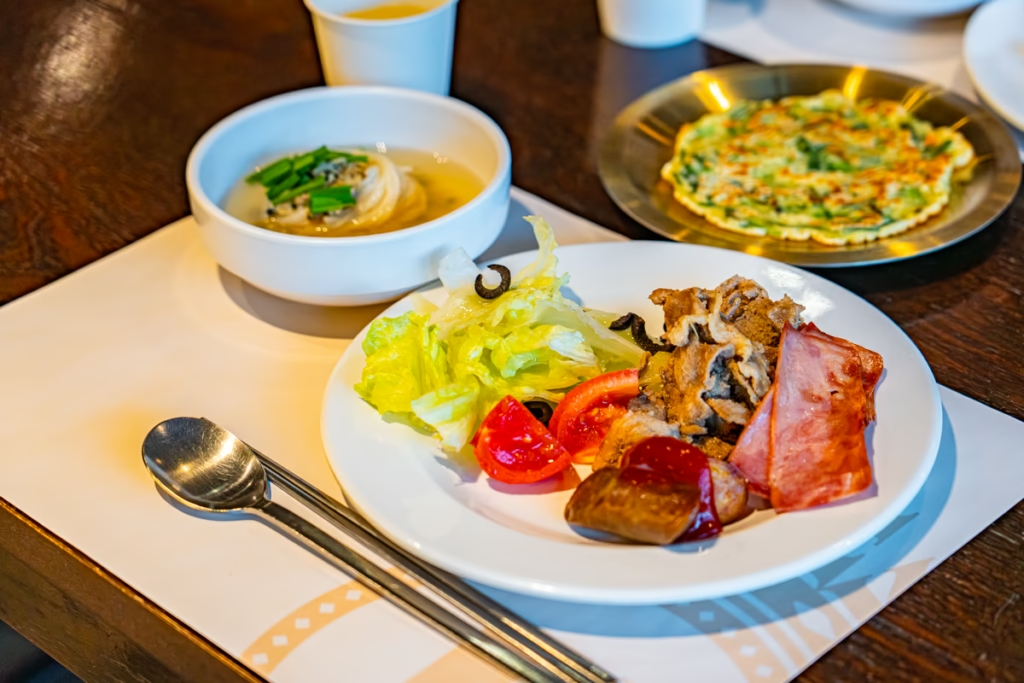
What caught me off guard was the regional commitment. Four separate dishes use jaecheop (재첩), the tiny freshwater clams from the Seomjingang River that Hadong is famous for: jaecheop soup, jaecheop salad with vinegar, jaecheop seafood pancake, and jaecheop noodles. Add Hadong green tea rice, Hwagae Market-style gukbap, and wild mountain herbs from Jirisan, and roughly a third of the 50-item spread is hyper-local. The jaecheop soup was the standout — milky, deeply savory, the kind of clean umami that makes you go back for a second bowl without thinking about it.
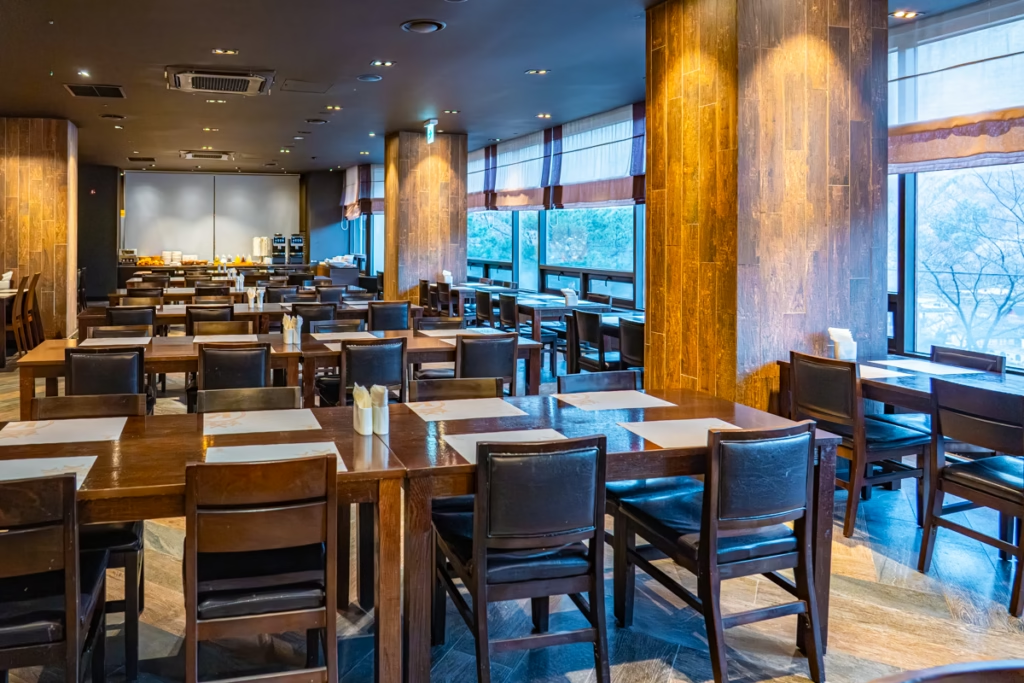
At ₩25,900 per adult (₩15,900 for children aged 37 months to 13, free under 36 months), it’s not cheap for a buffet. But in a valley where restaurants close by 8 p.m. and breakfast options are effectively zero, the pricing reflects geography as much as quality. I’d pay it again without hesitating, specifically for the jaecheop soup and the fact that it buys you a proper meal before a 6 km walk.
If you’re arriving late for a next-morning walk, the resort’s TO-GO service (chicken and pizza, ₩25,900, available 18:00–21:00) or the basement convenience store (open until midnight) are your dinner options. Surrounding restaurants close by 8 p.m. without exception. Plan accordingly — or stop at Hwagae Market on the drive in and bring food with you, which is what I did the second time, having learned the hard way on the first.
Ssanggye Myeongcha and Hwagae Market: Tea Culture and Local Food Worth the Stop
Hadong produces some of Korea’s oldest wild-harvested green tea, and the best place to experience it before heading home is Ssanggye Myeongcha (쌍계명차), a heritage tea brand established in 1966 whose main shop sits right on the road between Hwagae Market and the Simni Road entrance. The ground floor is a working teahouse; the second floor houses a small tea museum. The building itself won the Gyeongsangnam-do Architecture Award in gold — it’s a striking angular structure that somehow fits the valley rather than fighting it.
Order the Ujeon (우전) if you want to understand what Hadong tea actually tastes like at its best. It’s the first spring harvest, picked before the grain rains, and the flavor profile is sweeter and less astringent than anything you’ve had from a convenience store bottle. Green tea ice cream and cherry blossom tea are also on the menu for those who want something cold.
Hwagae Market itself is worth 30 minutes on foot. It’s a compact traditional market selling wild green tea, deodeok root, Jirisan mountain herbs, and Seomjingang dried fish. The jaecheop-guk stalls and sanchae bibimbap vendors are solid for a quick lunch. During the festival period, temporary roadside stalls line the approaches — pricing and hygiene vary noticeably, so eat from the permanent market structures if you want consistency. If your spring itinerary extends east toward the southern coast and Geoje Island, Hwagae Market is a natural refueling stop on the drive out.
Practical Manual
| Category | Details |
|---|---|
| Simni Road Address | 142, Hwagae-ro, Hwagae-myeon, Hadong-gun, Gyeongsangnam-do / 경상남도 하동군 화개면 화개로 142 |
| Naver / Kakao Map | 하동 십리벚꽃길 |
| Admission | Free, open year-round, 24 hours |
| 2026 Festival Dates | March 27–29 (27th Hwagae Market Cherry Blossom Festival) |
| Live Bloom CCTV | flower.hadong.go.kr |
| Best Time to Walk | Before 07:00 a.m. during peak bloom week (typically late March–early April) |
| Road Length | ~6 km one way (Hwagae Market to Ssanggyesa Temple), flat, ~90 min walk |
| Traffic Control | Car-free zones + one-way flow on festival weekends and the following weekend |
| Parking | Hwagae Market public lot (1 hr free), Ssanggyesa lot, roadside temp lots (festival only) |
| EV Charging | Hwagae Market Lot 1, Hwagae-myeon Office, Ssanggyesa lot — low count, high competition |
| From Seoul | ~3.5 hrs by car / KTX to Jinju + 60-min drive |
| From Busan | ~2 hrs via Namhae Expressway |
| Kensington Resort | 532-6, Ssanggye-ro, Hwagae-myeon, Hadong-gun / 경남 하동군 화개면 쌍계로 532-6 |
| Naver / Kakao Map | 켄싱턴리조트 지리산하동 |
| Resort Phone | 055-880-8000 |
| Check-in / Check-out | 15:00 / 11:00 |
| Resort Parking | Free (surface + underground) — doubles-up during peak bloom |
| Breakfast Buffet | “Taste of Hadong,” B1 Numaru / 07:30–10:00 (last entry 09:30) / ₩25,900 adult, ₩15,900 child |
| Convenience Store | B2, 07:30–24:00 |
| TO-GO Service | 18:00–21:00 (LO 20:50), chicken & pizza ₩25,900, pick up at front desk |
| Ssanggye Myeongcha | 30, Hwagae-ro, Hwagae-myeon / 경남 하동군 화개면 화개로 30 / Daily 09:00–20:00 (LO 18:00) |
| Inquiries | Hadong County Tourism ☎ 055-880-2651 |