
Table of Contents
Transparency Note: This guide contains affiliate links. If you make a purchase, I may earn a commission at no extra cost to you—allowing me to keep providing expert, gear-tested travel insights.
The Busan Museum of Modern History sits inside a former Bank of Korea branch building in Jung-gu, the original commercial heart of Busan’s port district. Admission is free across every floor. The building is a designated Busan cultural heritage site, housing permanent and rotating exhibitions on Korean colonial history, a contemporary art gallery installed inside four decommissioned bank vaults, and a specialty espresso bar operating out of the old customer-facing banking hall.
For international visitors, Jung-gu is roughly 30 minutes by metro from Busan Station, which itself is 2.5 hours from Seoul by KTX. The neighborhood sits adjacent to BIFF Square and Yongdusan Park—dense with history and walkable.
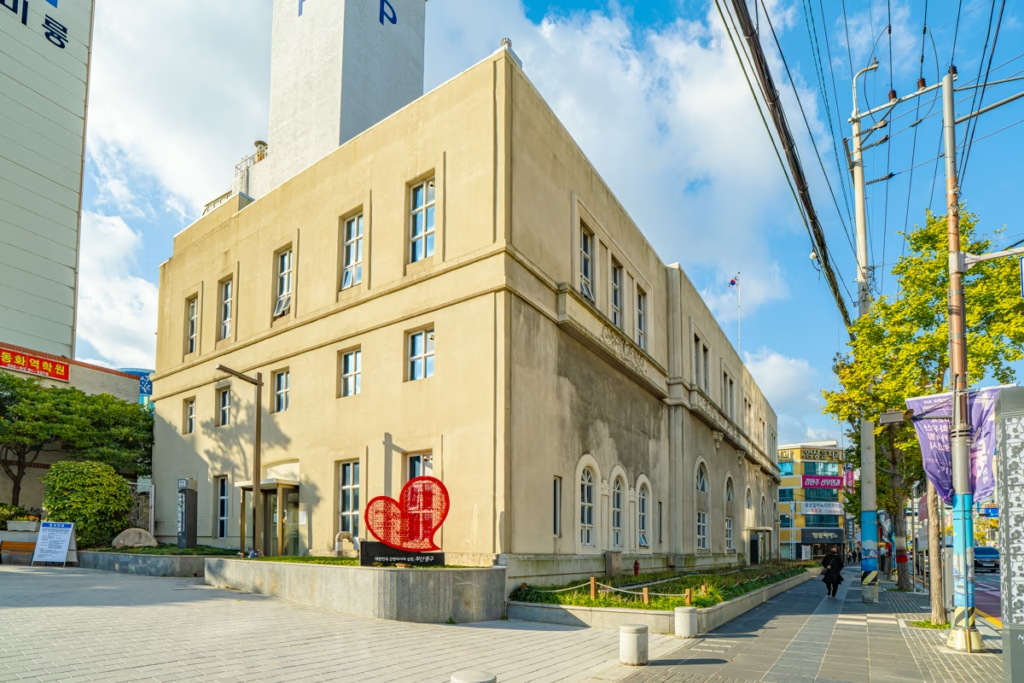
A Building With More History Than Most Museums Inside It
The main building served as the Busan headquarters of the Bank of Korea for decades before its conversion. The architecture reflects the institutional gravitas of early twentieth-century financial construction—thick masonry walls, high ceilings, a formal banking floor designed to project permanence. That structural seriousness now works in the museum’s favor.
The annex building across the street carries a heavier history. It was built by the Oriental Development Company (동양척식주식회사), a Japanese colonial-era institution central to land expropriation and agricultural extraction during the occupation period. After Korea’s liberation, the same building operated for fifty years as the United States Cultural Center. It returned to public Korean ownership after a sustained civic campaign—a significant, hard-won outcome documented inside the annex itself.
Visiting both buildings together as a single itinerary traces a substantial arc of Busan’s modern history in under two hours.
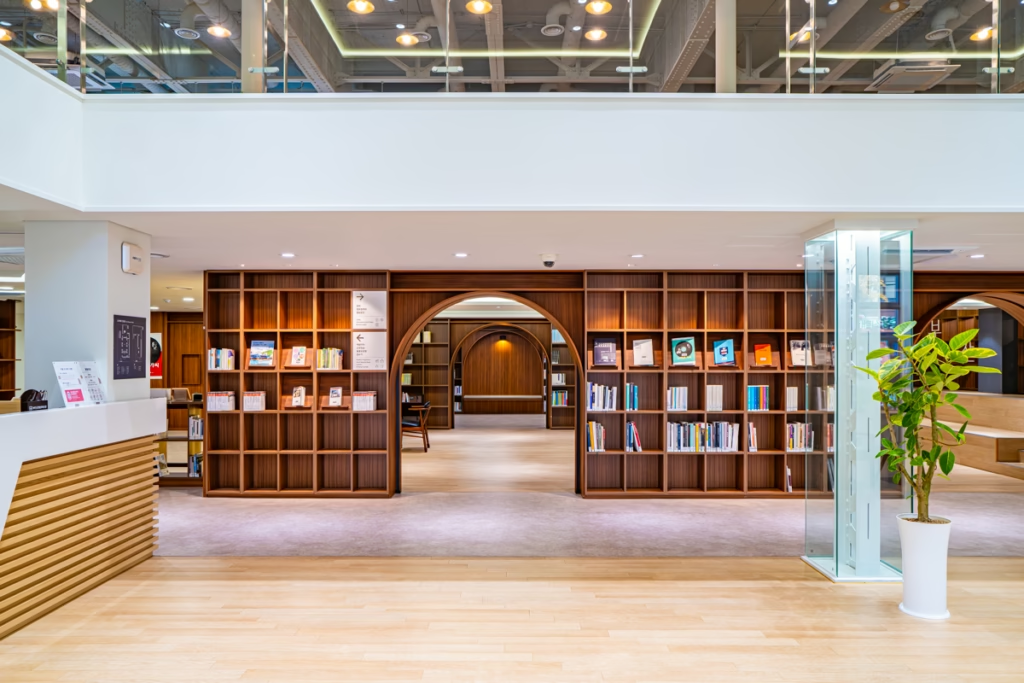
Busan Museum of Modern History: A Floor-by-Floor Guide
The Busan Museum of Modern History is organized across five levels in the main building. Take the elevator to the fourth floor and work downward—the exhibitions are sequenced chronologically, so this order places the earliest history first and leaves the archive and children’s space as a natural wind-down before descending to the basement vault gallery.
4F — Exhibition Room 2: Liberation, Industrialization, and Democracy
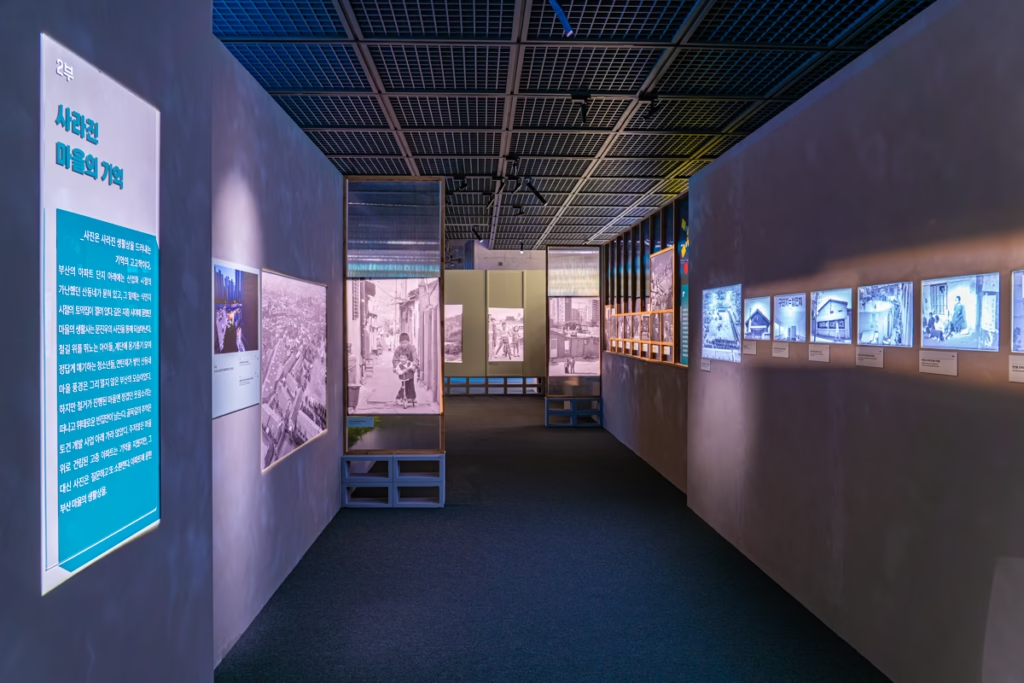
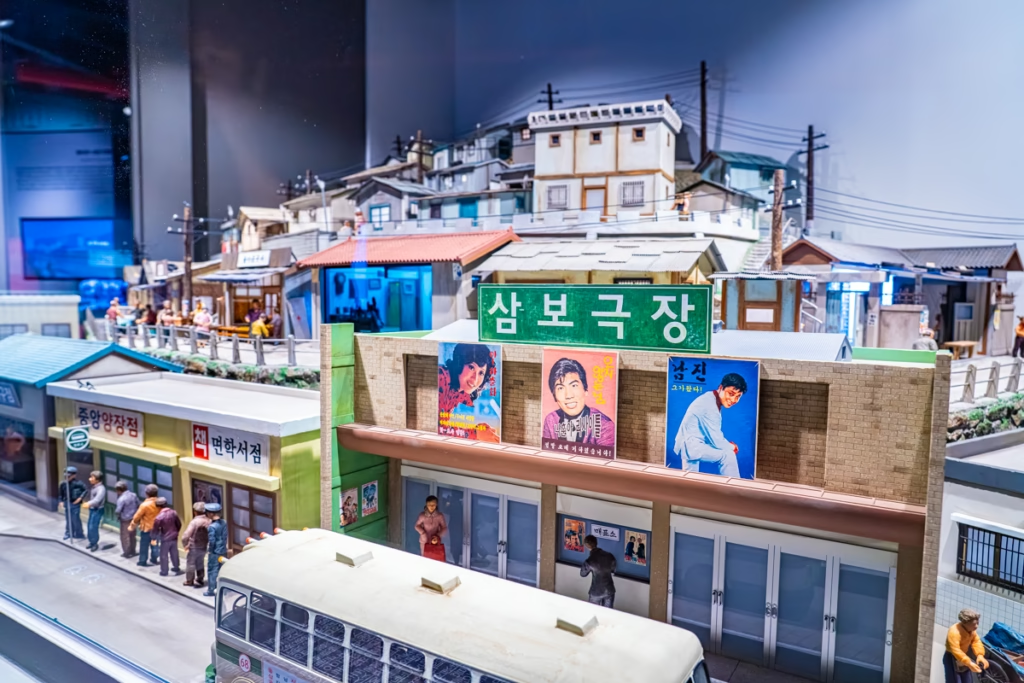
Start here. The fourth floor covers the post-1945 period—Korea’s liberation, the Korean War years when Busan served as the country’s wartime provisional capital from 1950 to 1953, the decades of rapid industrialization that followed, and the Buma Democratic Uprising of 1979. That pro-democracy movement, rooted in Busan and neighboring Masan, directly preceded the fall of the Park Chung-hee government. It is one of the least-discussed events in Korea’s modern history among international visitors, and the exhibition covers it with appropriate depth.
3F — Exhibition Room 1: Modern City Busan
The third floor works backward in time, covering Busan’s urban formation from the opening of the port in 1876 through the Japanese colonial period. Maps, archival photographs, and administrative documents reconstruct how a coastal trading outpost was systematically reshaped into an industrial port city under colonial governance. Visiting this floor after the fourth creates a sense of historical reversal that reinforces how abrupt and imposed the city’s modern transformation was.
2F — Special Exhibition Room
The second floor hosts rotating thematic exhibitions that change annually. Check the museum’s official website before visiting to confirm what’s currently showing.
1F — Bank of Korea Archive Room
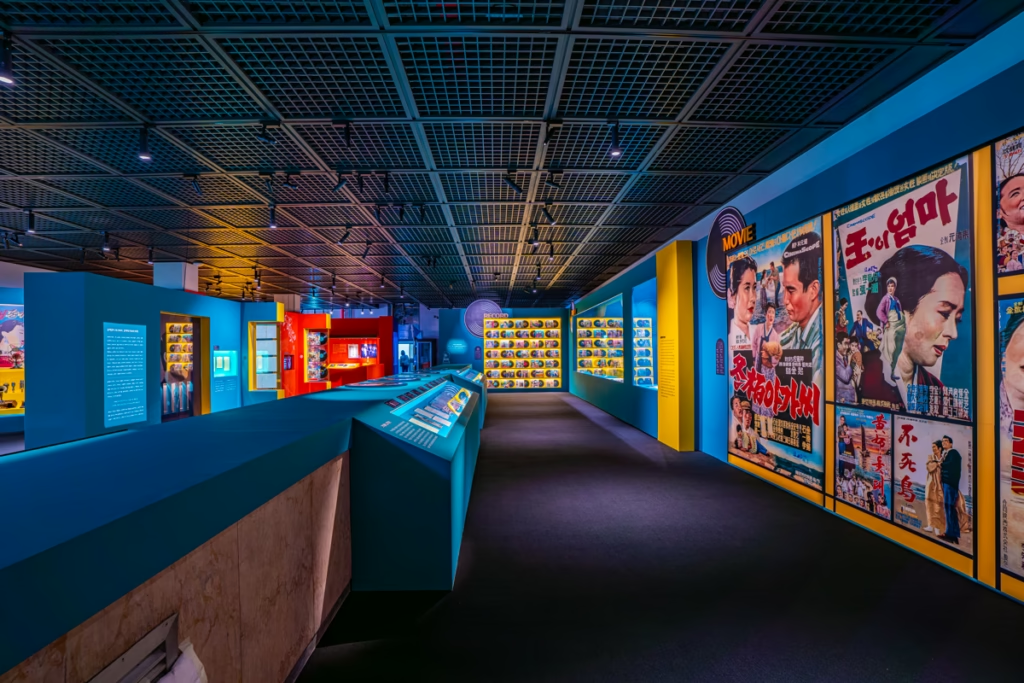
The ground floor archive displays physical currency issued by the Joseon Bank in the early 1900s alongside early issues of the Korean won. A brief stop—ten to fifteen minutes—but the specimens are well-preserved and genuinely rare outside of specialist collections.
Mezzanine — Children’s Experience Room “Deullangnallak”
A hands-on space aimed at younger visitors. Relevant for families traveling with children; otherwise easily skipped.
The Vault Art Gallery: Contemporary Art Inside Four Former Strongrooms
The basement is the most architecturally distinctive space in the Busan Museum of Modern History. Four bank vaults—sealed for decades behind blast-resistant doors and iron lattice gates—now function as dedicated contemporary art galleries. The heavy steel doors and original vault mechanisms remain intact. The contrast between the industrial containment infrastructure and the works installed inside it is deliberate and effective.
Lighting is entirely artificial and controlled. With no windows and sealed walls originally rated to withstand nuclear events, the curators work exclusively with installed fixtures, producing environments that shift the readings of sculpture, painting, installation, and video work in ways that a conventional white-cube gallery cannot. This is also the most photogenic section of the Busan Museum of Modern History for interior work—stable light, strong geometry, and zero crowds on most weekdays. Flash photography is prohibited throughout the building, but the vault lighting handles available-light shooting well from ISO 1600 onward on a Sony a7R4 or equivalent full-frame sensor.
The Annex Building and the Weight of Colonial Memory
The Oriental Development Company was established in 1908, three years before formal annexation, and operated as a primary vehicle for extracting land, labor, and agricultural output from the Korean peninsula. Its Busan branch building survives in recognizable form on the same block as the main museum. The annex exhibitions document both the company’s operations and the building’s subsequent life as an American cultural institution—a layered story of geopolitics embedded in a single structure.
Visitors with an interest in Korea’s colonial history will find this an essential stop. It functions as a useful companion to Seoul-based sites that cover the same period from different angles. If you plan to extend your exploration of this era beyond Busan, the Seodaemun Prison History Hall in Seoul documents the detention and interrogation of independence movement figures, and the Hwaseong Independence Movement Memorial in Gyeonggi-do covers the Jeam-ri Massacre of 1919 on the actual site where it occurred.
CASA BUSANO: Espresso in the Former Banking Hall
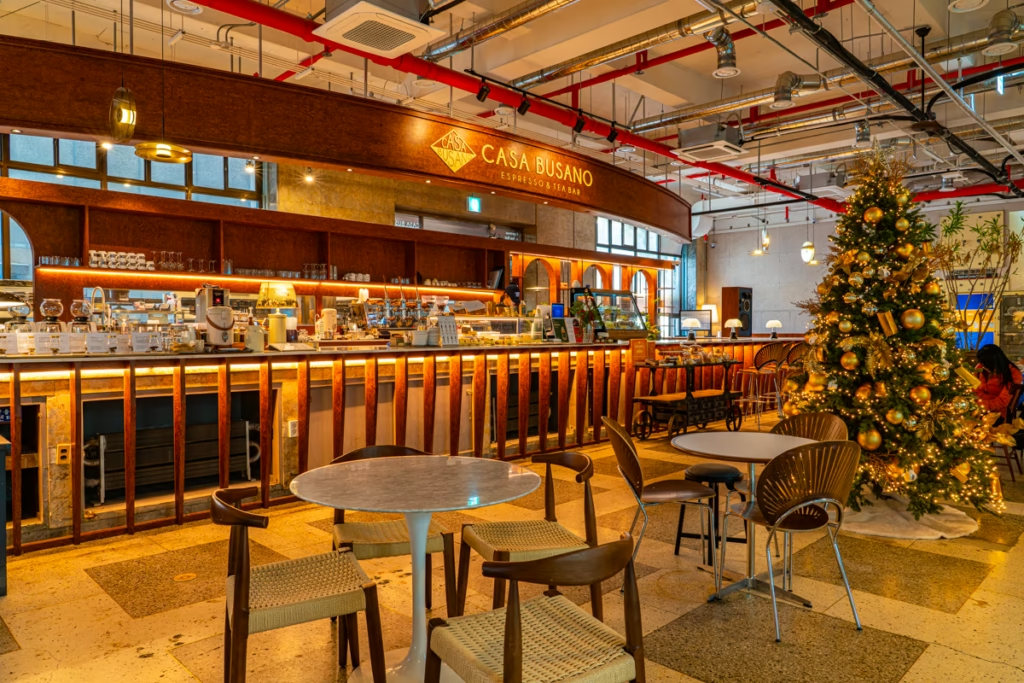
The ground floor of the Busan Museum of Modern History contains an Italian-style espresso bar called CASA BUSANO (까사부사노). The space occupies what was the public banking area—high ceilings, original proportions intact—with exposed overhead piping, warm wood tones, and heavy lighting fixtures added to the industrial shell. The result reads as functional and unhurried without trying too hard.
The menu is espresso-driven. The cortado is the most frequently recommended item. The visual centerpiece is a floor-to-ceiling gold-tinted display case filled with gold bar–shaped cakes—a direct reference to the vault downstairs. It is well-calculated for social media, and it works.
The seating is bar-style, consistent with the espresso bar format. This is not a place to spend two hours over a laptop. Order, sit at the counter, finish, and move on. One practical note: operating hours fluctuate—call ahead (0507-1339-6349) or check Naver Map for current hours before making this a destination in its own right.
For visitors who want to continue into Busan’s specialty coffee scene after leaving the museum, Yeongdo district is accessible by taxi in under ten minutes. Our guide to Momos Coffee Yeongdo covers the city’s World Barista Championship–winning roastery, which operates out of a converted harbor warehouse on the Bongnae-dong wharf.
If you are planning an overnight stay to cover the old downtown properly, the Nampo-dong and Jung-gu area has solid mid-range accommodation within walking distance of the museum. Browse hotels near Busan’s Jung-gu on Agoda to compare rates.
Planning Your Visit to the Busan Museum of Modern History
The Busan Museum of Modern History is open Tuesday through Sunday, 09:00–18:00, with last entry at 17:00. It is closed every Monday, on January 1, and on the day following a Monday public holiday. On the last Friday of each month—designated “Culture Day” nationally—hours extend to 20:00. Group docent tours are available by advance reservation through the museum’s website.
There is no on-site parking. Visitors arriving by car should use Yongdusan Public Parking (용두산공영주차장), a short walk away. Public transit is more practical: take Metro Line 1 to Jungang Station and use Exit 5; the museum entrance is a six-minute walk. Naver Map (search: 부산근현대역사관) is the most reliable navigation tool in this part of the city, where Google Maps coverage is limited.
Practical Information
| Category | Details |
|---|---|
| Official Name | Busan Museum of Modern History / 부산근현대역사관 (Busan Geunhyeondae Yeoksagwan) |
| Address | 112 Daecheong-ro, Jung-gu, Busan / 부산광역시 중구 대청로 112 |
| Naver / Kakao Map | Search: 부산근현대역사관 |
| Hours | Tue–Sun 09:00–18:00 (last entry 17:00) · Last Friday of month: until 20:00 |
| Closed | Every Monday · January 1 · Tuesday if Monday falls on a public holiday |
| Admission | Free |
| Transport | Metro Line 1 → Jungang Station (중앙역), Exit 5 → 6-min walk |
| Parking | No on-site parking · Yongdusan Public Parking (용두산공영주차장) nearby |
| Photography | Permitted without flash throughout |
| Group Tours | Docent reservations via museum website |
| Contact | 051-607-8000 |
| Recommended Stay | 2 hours (main building + annex) |
| Nearby Accommodation | Hotels near Busan Jung-gu on Agoda |